


07 Jun How To Step Up Your Outsource Accounting Service: A Complete Guideline
Outsourced accounting has evolved from a cost-saving tactic into a strategic growth engine for modern businesses. Today, companies no longer outsource accounting only to reduce overhead; they do it to gain real-time financial visibility, expert insights, compliance assurance, and scalable finance operations. This complete guideline explains how to step up outsourced accounting services to a premium, enterprise-grade level that delivers measurable business value.
Small enterprises go for outsourced accounting services in 37% of cases. The most typically outsourced procedures for smaller businesses are accounting and IT services.
Accounting and IT consistently rank as the most outsourced business functions worldwide. According to global B2B outsourcing studies, more than one-third of small and mid-sized enterprises now rely on third-party accounting and bookkeeping partners. As markets become more regulated and data-driven, outsourced accounting is no longer optional—it is a competitive advantage.
Key Takeaways
1. Presently outsourcing accounting and bookkeeping services is used by more than one-third of small enterprises. These are handled by the third party agent.
2. To avoid accounting errors, you need to get rid of your bad outsourced bookkeeping services, but first you need to figure out what they are.
3. Despite popular belief, outsourced accounting services do not have to be done within the company. However, you must determine if you have the requisite abilities and expertise to perform this job.
What Is Outsourced Accounting?
Outsourced accounting refers to delegating part or all of a company’s finance and accounting operations to a specialized external service provider. These services may include bookkeeping, financial reporting, payroll, tax compliance, management accounting, treasury support, and CFO-level advisory.
Instead of building and maintaining an in-house finance department, businesses partner with accounting professionals who deliver structured, secure, and technology-enabled services. The scope, pricing, and service model depend on business size, complexity, and strategic objectives.

How To Outsource Accounting Service: A Clear Guideline
Steps
1. Selecting the right provider for outsource accounting
2. Communication Standards for the accounting service
3. Choosing Your Package for accounting and finance
4. Turning Over Your Books for outsourced bookkeeping service
5. Maintaining Communication of accounting and finance
6. Reputation for outsourcing accounting and bookkeeping services.
Process
1. It is critical to properly weigh your alternatives before making a decision. Some aspects to consider while comparing are: cost, reliability, services available.
2. If you are concerned about handing over management of your accounting to a third party, search for a provider who is ready to keep open lines of communication.
3. Many outsourced accounting service companies will provide many packages. After you’ve decided on a provider, you’ll need to figure out which bundle is best for your business.
4. It will be time to hand over management of your funds to your accounting company once you’ve developed a connection with them and picked the proper package.
5. Even with the most reputable accounting services, it’s a good idea to double-check your financial statements and other documents on a frequent basis to ensure everything is in order.
6. When examining the reputation of various outsourced accounting services providers, keep in mind to check for evaluations from independent third-party sources.
Global Market Insights & Statistics
|
Indicator |
Global Insight |
|
SMEs using outsourced accounting |
35%–45% |
|
Average cost reduction |
25%–60% |
|
Reporting cycle improvement |
Up to 50% faster |
|
Error reduction rate |
40%–70% |
|
Businesses planning to increase outsourcing |
70%+ |
These numbers highlight a clear trend: outsourcing accounting is no longer about survival—it is about performance optimization.
3 Key Arguments for Outsourcing Accounting
Outsourced accounting has gained global acceptance due to its ability to solve real operational and strategic challenges. The following key arguments explain why businesses across industries increasingly depend on third-party accounting partners. These points highlight practical realities, risk considerations, and performance benefits that directly impact financial accuracy, compliance strength, and long-term business sustainability.
1. Accounting Is No Longer Just Record-Keeping
Modern accounting drives strategy. Financial data supports budgeting, forecasting, investment decisions, and risk management. Outsourcing gives access to this expertise without building internal teams.
2. Quality Over Cost
Low-quality bookkeeping creates compliance risks, financial inaccuracies, and poor decision-making. Replacing weak outsourced services with a structured, professional provider protects long-term business value.
3. Location Is No Barrier
Outsourced accounting does not need to operate inside your organization. Secure cloud systems, standardized workflows, and communication protocols ensure seamless collaboration across borders.
Global Outsourced Accounting Statistics
|
Metric |
Latest Industry Data |
|
Businesses outsourcing accounting functions |
37%–45% globally |
|
SMEs outsourcing bookkeeping |
Over 40% |
|
Average cost savings achieved |
25%–60% |
|
Reduction in accounting errors |
40%–70% |
|
Companies planning to expand outsourcing |
30%–50% |
Why Businesses Choose Outsourced Accounting Services
Businesses adopt outsourced accounting services for reasons that go far beyond cost reduction. Strategic pressure, regulatory complexity, talent shortages, and the need for real-time financial insight all contribute to this shift. The following factors explain the most common and practical motivations behind outsourcing accounting and finance functions.
-
Lack of Qualified Personnel
Hiring and retaining skilled accountants is expensive and time-consuming. Outsourcing provides instant access to experienced professionals with industry-specific knowledge.
-
Time Constraints
Business owners and management teams cannot focus on growth while handling accounting complexities. Outsourced accounting removes operational burdens and frees leadership time.
-
Profitability Focus
Professional accounting firms deliver insights, dashboards, and financial analysis that improve margins, pricing strategies, and cost control.
-
Cost-Efficient Operations
Outsourced accounting reduces fixed costs related to salaries, benefits, training, software licenses, and infrastructure.
-
Scalable Finance Function
Outsourcing allows businesses to scale accounting services up or down without operational disruption.
When Outsourced Accounting Works Best
Outsourced accounting does not deliver the same value in every situation. Its effectiveness depends on business size, growth stage, internal capabilities, and operational complexity. Based on real-world experience with international and regional organizations, the following scenarios represent the conditions where outsourcing accounting and bookkeeping produces the strongest results.
Outsourcing accounting and bookkeeping delivers maximum impact when:
- A small business needs expertise beyond an office administrator but not a full-time accountant.
- Companies cannot find skilled finance professionals at a reasonable cost.
- Growing organizations require scalable accounting systems.
Data-driven decision-making is at the core of modern accounting outsourcing. Updated global statistics clearly show how outsourced accounting improves efficiency, reduces costs, and strengthens compliance. The following statistics and benchmarks are compiled from global outsourcing studies, SME finance surveys, and international consulting reports, reflecting current market realities and business behavior.
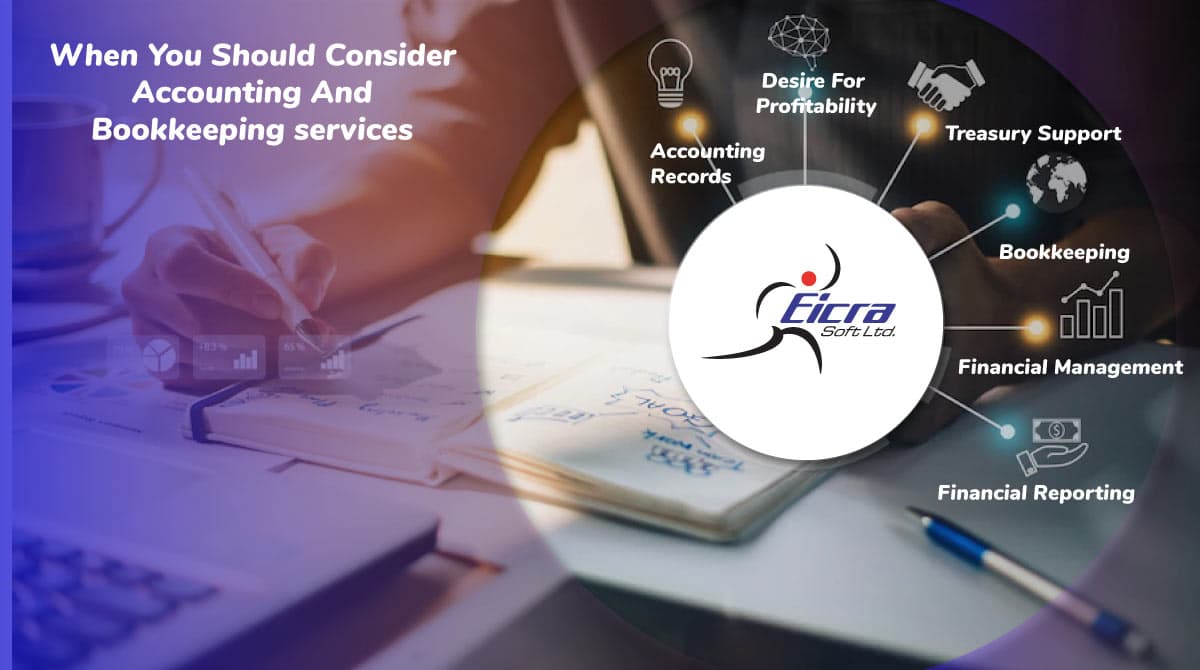
Our Accounting & Bookkeeping Services
-
1. Financial Reporting
Accurate, structured, and timely financial reports aligned with international standards. These reports support management decisions and stakeholder communication.
2. Financial Management
Dedicated finance professionals act as an extension of your management team, supporting budgeting, forecasting, and performance tracking.
3. Bookkeeping
Comprehensive bookkeeping services, including reconciliations between local books and corporate accounting systems.
4. Examination of Accounting Records
Detailed review of accounting records to identify errors, inconsistencies, and compliance risks, supported by secure IT-enabled services.
5. Treasury Support
Cash flow monitoring, electronic banking coordination, and payment management based on pre-approved authorization structures.
Step-by-Step Guide to Upgrading Outsourced Accounting
Step 1: Define Strategic Objectives
Clarify whether outsourcing aims to reduce costs, improve reporting, ensure compliance, or support growth.
Step 2: Assess Current Accounting Gaps
Review existing processes, error rates, reporting delays, and compliance risks.
Step 3: Select the Right Partner
Choose providers with industry experience, strong references, and scalable service models.
Step 4: Design Clear Workflows
Define responsibilities, timelines, approval hierarchies, and communication channels.
Step 5: Implement Performance Metrics
Track accuracy, turnaround time, reporting quality, and responsiveness.
Step 6: Continuous Review & Optimization
Regular performance reviews ensure alignment with business goals.
7 Expert Tips for Outsourcing Accounting Successfully
Selecting and managing an outsourced accounting partner requires structured planning and ongoing oversight. These expert tips focus on minimizing risk, improving collaboration, and ensuring consistent service quality. When applied correctly, they help businesses build long-term, value-driven outsourcing relationships rather than short-term cost-based engagements.
- Define clear needs and expectations
- Prioritize industry experience
- Review client references carefully
- Ensure strong communication protocols
- Evaluate data security standards
- Agree on transparent pricing models
- Conduct regular performance reviews
Common Risks & How to Mitigate Them
- Poor provider selection: Mitigated through due diligence
- Communication gaps: Solved with structured reporting
- Data security concerns: Addressed via enterprise security controls
The future of outsourced accounting includes AI-driven analytics, predictive forecasting, automated compliance monitoring, and integrated advisory services. Businesses that adopt advanced outsourcing models gain a decisive advantage in efficiency, transparency, and scalability.
Conclusion
Outsourced accounting has transformed into a strategic business function. Companies that step up their outsourcing approach gain more than cost savings—they gain financial clarity, compliance confidence, and growth readiness. With the right partner, structured processes, and secure technology, outsourced accounting becomes a long-term value driver rather than a support function.
Organizations that invest in premium outsourced accounting services position themselves for sustainable growth, stronger governance, and smarter financial decisions in an increasingly complex business environment.
Sorry, the comment form is closed at this time.